Watch Dr. Sarraj explain
Trusted resources
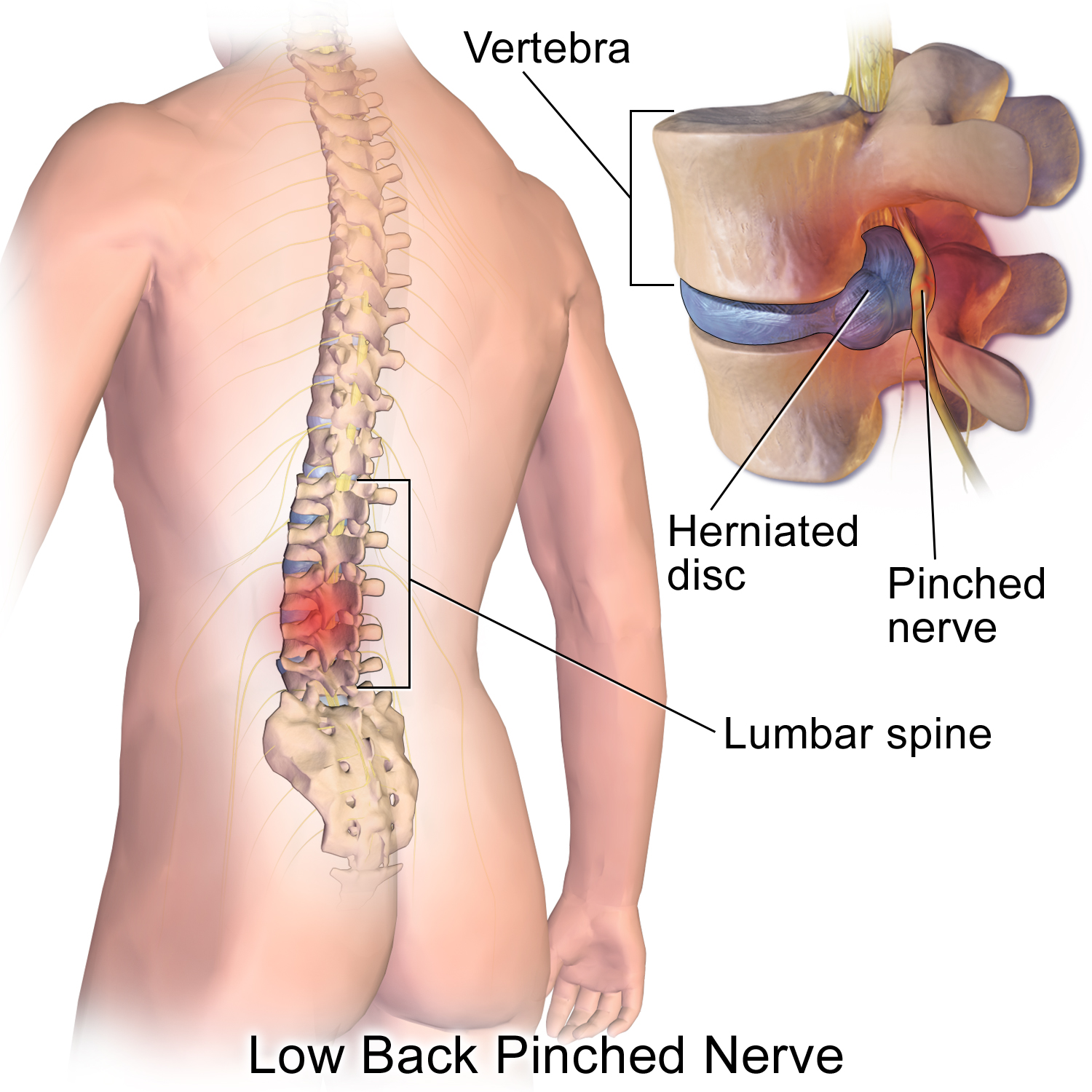
A lumbar disc herniation pressing on a nerve, one of the conditions an endoscopic procedure may treat.
BruceBlaus (Blausen Medical Communications) · CC BY 3.0 · View full size · Image credits
What the operation involves
An endoscope is a small camera that allows the surgeon to see and treat the area pressing on a nerve through a small opening. Depending on the problem, disc material or other tissue is removed to create space.
The approach depends on the location and type of compression. A smaller incision does not make this the right operation for every patient; the goals and risks still need an individual discussion.
Who it suits
Selected disc herniations, and narrowing of the nerve exit channel, in people whose leg symptoms dominate. It is a targeted operation and it is not right for everyone — extensive multi-level stenosis, instability, and deformity need different solutions.
Suitability is judged on your MRI and examination together. Being unsuitable for an endoscopic approach is common and does not mean a worse outcome; it means a different operation fits better.
Recovery
Your hospital stay and recovery plan depend on the operation, your health, and how you are recovering. The team will explain the expected plan before surgery and update it before you go home.
Follow your individual instructions for wound care, medicines, collars or braces, lifting, driving, work, and physiotherapy. Nerve symptoms can improve gradually, and some may persist. Use the recovery guide below to prepare questions for your follow-up.
Risks
As with any spinal decompression: infection, bleeding, a tear in the lining of the nerve sac, nerve injury, and recurrence of the herniation. There is also a possibility that the fragment cannot be adequately reached endoscopically and the approach has to be converted to an open microdiscectomy — this is discussed and consented for beforehand.
Questions for your appointment
- What is the main goal of this treatment for me?
- Which symptoms are likely to improve, and which may remain?
- What are the alternatives and the risks of waiting?
- What help will I need at home, and when can I return to my usual activities?
Educational information to support your consultation. The options, risks, and recovery described here may differ from your individual plan. Contact your treating team about new or changing symptoms.