Watch Dr. Sarraj explain
Trusted resources
Laminectomy
Read about making more room for the nerves through spinal decompression.
Patient guide · Opens in a new tabMayo ClinicMayoClinic.org spinal stenosis information
See the treatment overview and illustrated explanations on Mayo Clinic’s website.
Patient guide · Opens in a new tab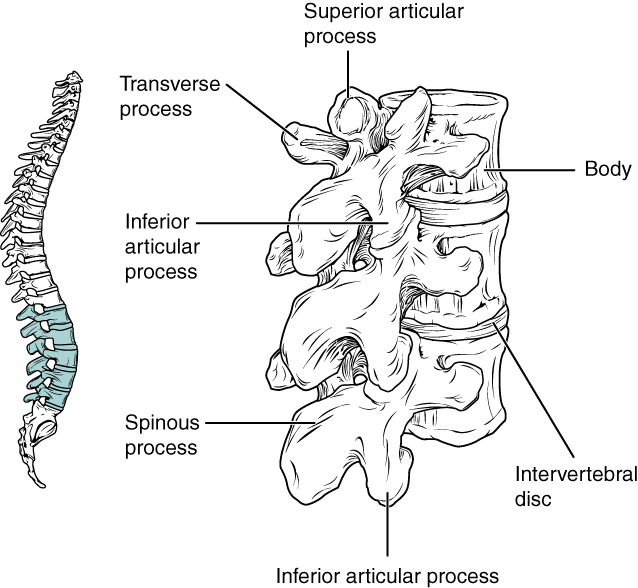
Bones of the lower back, shown from the side. A laminectomy removes part of the bony arch to make more room for the nerves.
OpenStax College · CC BY 3.0 · View full size · Image credits
What the operation involves
The thickened ligament and overgrown bone narrowing the spinal canal are removed to give the nerves room again. Where the segment is stable, nothing is fused and no metalwork is used.
Where possible the decompression is done in a way that preserves the facet joints and as much of the midline structure as the anatomy allows, since those contribute to stability.
Who it suits
Lumbar spinal stenosis where leg symptoms limit walking distance enough to interfere with daily life, and where conservative treatment has not given enough relief.
It treats the leg symptoms well. It is much less predictable for back pain, and that distinction is made explicit before any decision.
Recovery
Your hospital stay and recovery plan depend on the operation, your health, and how you are recovering. The team will explain the expected plan before surgery and update it before you go home.
Follow your individual instructions for wound care, medicines, collars or braces, lifting, driving, work, and physiotherapy. Nerve symptoms can improve gradually, and some may persist. Use the recovery guide below to prepare questions for your follow-up.
Risks
Infection, bleeding, dural tear, and nerve injury. Over time, some patients develop instability at the decompressed level or narrowing at an adjacent level, either of which may need further treatment.
Questions for your appointment
- What is the main goal of this treatment for me?
- Which symptoms are likely to improve, and which may remain?
- What are the alternatives and the risks of waiting?
- What help will I need at home, and when can I return to my usual activities?
Further reading
Educational information to support your consultation. The options, risks, and recovery described here may differ from your individual plan. Contact your treating team about new or changing symptoms.