Watch Dr. Sarraj explain
Trusted resources
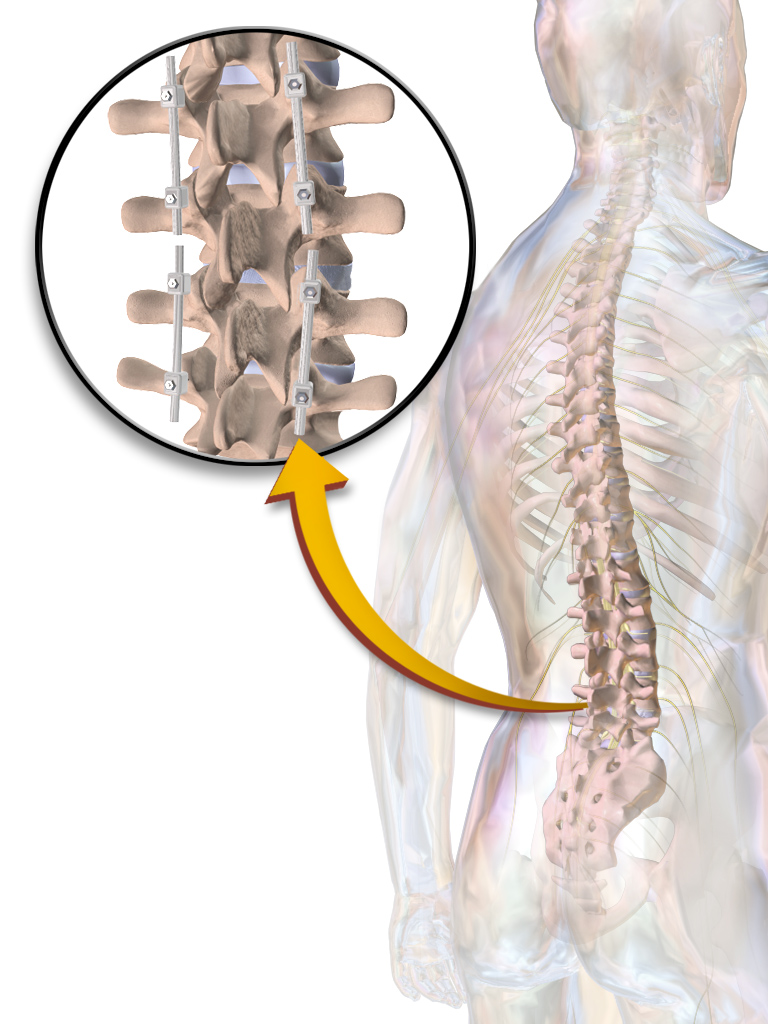
Illustration of rods and screws used for posterior lumbar stabilisation. The amount of fixation varies with the planned operation.
BruceBlaus (Blausen Medical Communications) · CC BY-SA 4.0 · View full size · Image credits
What the operation involves
Fusion uses bone graft, often with screws, rods, or a spacer, to help selected vertebrae heal together. A decompression may be performed at the same time to relieve pressure on nerves.
Your surgeon may discuss an approach from the back (such as TLIF or PLIF), the front (ALIF), or the side. Some operations use minimally invasive techniques. The approach is chosen for your anatomy and treatment goals.
Who it suits
Fusion may be considered when stability or alignment is part of the problem, including selected cases of spondylolisthesis. Not everyone with a slipped vertebra or back pain needs fusion.
Ask why fusion is recommended in your case, which levels are involved, and whether decompression alone or non-operative care is an alternative.
Recovery
Your hospital stay and recovery plan depend on the operation, your health, and how you are recovering. The team will explain the expected plan before surgery and update it before you go home.
Follow your individual instructions for wound care, medicines, collars or braces, lifting, driving, work, and physiotherapy. Nerve symptoms can improve gradually, and some may persist. Use the recovery guide below to prepare questions for your follow-up.
Risks
Infection, bleeding, dural tear, and nerve injury. Specific to fusion: failure of the bone to unite, screw loosening or malposition, and degeneration at the adjacent level over subsequent years. Some patients need further surgery for these.
Questions for your appointment
- What is the main goal of this treatment for me?
- Which symptoms are likely to improve, and which may remain?
- What are the alternatives and the risks of waiting?
- What help will I need at home, and when can I return to my usual activities?
Educational information to support your consultation. The options, risks, and recovery described here may differ from your individual plan. Contact your treating team about new or changing symptoms.