Watch Dr. Sarraj explain
Trusted resources
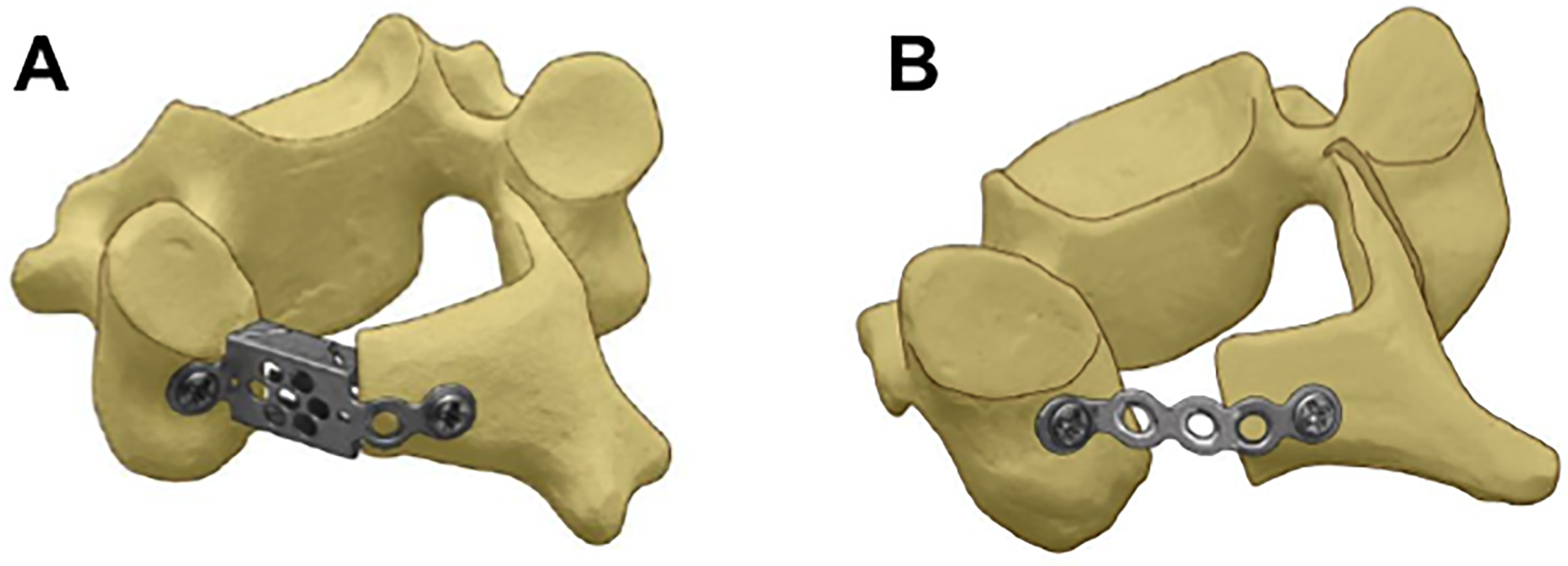
Examples of plates holding a cervical lamina open after laminoplasty: a plate with a spacer (A) and a miniplate (B).
Yukoh Ohara, Takeshi Hara, Alejandro A. Espinoza Orías, Satoshi Tani, Nozomu Inoue and Junichi Mizuno · CC BY 4.0 · View full size · Image credits
What the operation involves
Laminoplasty enlarges the spinal canal through the back of the neck. Small implants hold the expanded bony arch in position, creating more room for the spinal cord.
It avoids a fusion across the treated levels. Some movement may be preserved, although stiffness and a reduction in neck movement can still occur.
Who it suits
Cervical myelopathy caused by compression across multiple levels, in a neck that still has reasonable alignment.
It is less suitable where the neck has lost its natural curve, where compression is predominantly at the front, or where there is significant instability or severe axial neck pain — in those situations an anterior approach or a fusion may serve better.
Recovery
Your hospital stay and recovery plan depend on the operation, your health, and how you are recovering. The team will explain the expected plan before surgery and update it before you go home.
Follow your individual instructions for wound care, medicines, collars or braces, lifting, driving, work, and physiotherapy. Nerve symptoms can improve gradually, and some may persist. Use the recovery guide below to prepare questions for your follow-up.
Risks
Infection, bleeding, and — uncommonly — injury to the spinal cord or nerve roots. Some patients develop new shoulder or arm weakness after decompression, which usually recovers. Persistent neck pain and loss of some neck movement are recognised issues.
Questions for your appointment
- What is the main goal of this treatment for me?
- Which symptoms are likely to improve, and which may remain?
- What are the alternatives and the risks of waiting?
- What help will I need at home, and when can I return to my usual activities?
Educational information to support your consultation. The options, risks, and recovery described here may differ from your individual plan. Contact your treating team about new or changing symptoms.